
Solvent-Free Electrode Manufacturing
Solvent-free manufacturing of Li-ion battery
Lithium-ion battery electrodes were manufactured using a new, completely dry powder process. The solvents used for conventional slurry-cast electrodes have been completely removed. Thermal activation time has been greatly reduced due to the time and resource-demanding solvent evaporation process needed with slurry-cast electrode manufacturing being replaced by a hot rolling process. Removing the solvent and drying process allows large-scale Li-ion battery production to be more economically viable in markets such as automotive energy storage systems.
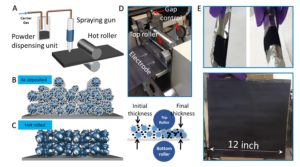
- Ludwig, Z. Zheng, W. Shou, Y. Wang, H. Pan*, “Solvent-Free Manufacturing of Electrodes for Lithium-ion Batteries”, Nature Publication Group – Scientific Reports, 6, 23150, (2016).
- Ludwig, J. Liu, I. Chen, Y. Liu, W. Shou, Y. Wang*, and H. Pan*, “Understanding Interfacial-energy-driven Dry Powder Mixing for Solvent-Free Additive Manufacturing of Li-ion Battery Electrodes”, Advanced Materials Interfaces, 4 (11), 1700570, (2017).
- Y. Liu, X. Gong, C. Podder, F. Wang, Z. Li, J. Liu, J. Fu, X. Ma, P. Vanaphuti, R. Wang, A. Hitt, Y. Savsatli, Z. Yang, M. Ge, W.Lee, B. Yonemoto, M. Tang, H. Pan*, Y. Wang*, Roll-to-roll Solvent-free Manufactured Electrodes for Fast-charging Batteries, Joule, 952-970, (2023).
Solvent-free manufacturing of gas diffusion electrode for enhanced CO2 reduction
A tandem gas diffusion electrode (GDE) leveraging hierarchically engineered microgranules enables efficient CO₂ electroreduction under dilute CO₂ conditions. A key innovation lies in the solvent-free precision assembly of metal-organic-framework, carbon nanotubes and copper nanoparticles. The fabricated tandem GDE demonstrates 39±1% Faradaic efficiency toward C₂H₄ and a record high partial current density of 99 mA cm-2 at a 15 vol.% CO₂ stream.

- J. Pellessier, X. Gong, B. Li, J. Zhang, Y. Gang, K. Hambleton, C. Podder, Z. Gao, H. Zhou, G. Wang, H. Pan*, Y. Li*, “PTFE Nanocoating on Cu Nanoparticles through Dry Processing to Enhance Electrochemical Conversion of CO2 towards Multi-Carbon Products”, Journal of Materials Chemistry A, (2023).
- K. Wu, C. Racine, A. Badreldin, S. Wang, Z. Han, H. Zhou, Y. Li*, H. Pan*, “Solvent-Free Manufacturing of Multifunctional Gas Diffusion Electrode Architectures for Enhanced CO2 Conversion From Low-Concentration Streams.” Advanced Functional Materials (2026).
Additive Manufacturing of Electronics
Aerosol printing of Li-ion battery
Lithium-ion batteries (LIBs) are widely used in consumer electronics due to the advantages of rechargeability and high energy density. Commercial LIBs are usually fabricated in fixed geometry such as cylinder, coin, and pouch. Nevertheless, with the growing demands on specialized applications such as wearable electronics and on-device power systems, customizable LIBs with an arbitrary geometry on 3D structures need to be developed along with the packaging, integrating, and manufacturing approaches. For such a purpose, aerosol printing would be ideal due to its unique advantage of flexible working distance, allowing deposition on non-planar substrates with multi-scale surface topologies. This work develops the aerosol printing of electrodes for LIBs with arbitrary geometry, tailorable thickness, and non-planar substrates.
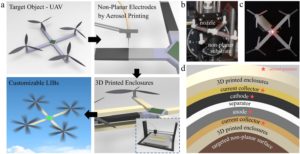
- Yu, Y. Liu, H. Pham, S. Sarkar, B. Ludwig, I. Chen, W. Everhart, J. Park, Y. Wang, H. Pan*, “Customizable Non-planar Printing of Lithium-ion Batteries”, Advanced Materials Technologies, 4 (11), 19000645, (2019).
- Yu, X., Pan, H., “Aerosol Jet Printing of Electrodes for Lithium-ion Batteries”, International Manufacturing Science & Engineering Conference (MSEC), 2019. (Presentation only)
- Yu, X., Chen, I., Sarkar, S., Park, J., Pan, H., “Direct Aerosol Printing of Lithium-ion Batteries”, IMAPS 50th International Symposium on Microelectronics, Oct 2017.
Laser-Based Micro- and Nano- Additive Manufacturing
Laser sintering nanoparticles for flexible electronics
We develop low-cost manufacturing of flexible electronics, such as bioresorbable electronics, by laser processing of nanoparticles.

- Yu, W. Shou, B. K. Mahajan, X. Huang*, and H. Pan*, “Materials, Processes and Facile Manufacturing for Bioresorbable Electronics: A Review”, Advanced Materials, 30 (28), 1707624, (2018).
- Shou, B. Mahajan, B. Ludwig, X. Yu, J. Staggs, Xian Huang*, H. Pan*, “Low‐Cost Manufacturing of Bioresorbable Conductors by Evaporation–Condensation‐Mediated Laser Printing and Sintering of Zn Nanoparticles”, Advanced Materials, 29 (26), 1700172, (2017).
Femtosecond laser micro/nanoscale metal printng
Currently light-based 3D printing with sub-micron features is mainly developed based on photosensitive polymers or inorganic-polymer composite materials. To eliminate polymer/organic additives, a strategy for direct 3D assembly and printing of metallic nanocrystals without additives is presented. Ultrafast laser is used to non-equilibrium heat nanocrystals and induce ligand transformation, which triggers the spontaneous fusion and localized assembly of nanocrystals. The process is due to operation of hot electrons as confirmed by a strong dependence of printing rate on laser pulse duration varied in the range of electron-phonon relaxation time. Using the developed Laser Induced Ligand Transformation (LILT) process, direct printing of 3D metallic structures at micro and sub-micron scales is demonstrated. Facile integration with other microscale additive manufacturing for printing 3D device containing multiscale features is also demonstrated.

- C. Podder, X. Gong, H. Pan*, “Ultrafast, non-equilibrium and transient heating and sintering of nanocrystals for nanoscale metal printing”, Small, (2021).
- C. Podder, X. Gong, X. Yu, W. Shou, H. Pan*, “Submicron Metal 3D Printing by Ultrafast Laser Heating and Induced Ligand Transformation of Nanocrystals”, ACS Applied Materials & Interfaces, 13 (35), 42154–42163 (2021).
- H. Pan, C. Podder, W. Shou, X. Yu, “Three-dimensional Laser-assisted Printing of Structures from Nanoparticles”, US Patent App. 17/170,405, 2021
Modeling and Simulations
Modeling cohesive powder spreading
The spreading of cohesive powders is an emerging area of interest in additive manufacturing. A continuum mechanics-based mathematical model is developed to investigate cohesive powder spreading using a spreading roll, building upon established frameworks in bulk solids. A rheological measurement procedure is formulated to characterize powder cohesion strength and rheological properties. Measured powder properties and spreading process parameters are provided as inputs to the model to predict the minimum achievable spread powder layer thickness, based on the major principal stress and the unconfined yield strength of the powder.

- J. Gao, H. Pan, “Quasi-static Spreading of Cohesive Microspheres on a Substrate: An Analytical and Experimental Study”, Powder Technology, 121799, (2025)
Discrete Element Method simulations of micro/nanopowder mixing
Discrete Element Method simulation is developed and used to study the mixing characteristics of dry electrode powder materials for solvent-free Li-ion battery manufacturing. Due to the size of the particles being in the sub-micron to micron size range, the mixing characteristics are heavily dependent on van der Waals adhesive forces between the particles. DEM is used to predict the mixing characteristics of different particle systems, such as active material mixed with binder particle additives.
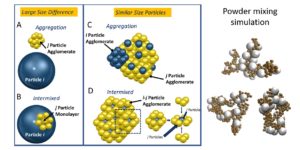
1. B. Ludwig, J. Liu, Y. Liu, Z. Zheng, Y. Wang, and H. Pan*, “Simulation of Micro/Nano-powder Mixing Characteristics for Dry Spray Additive Manufacturing of Li-ion Battery Electrodes”, ASME Journal of Micro- and Nano-Manufacturing, 5 (4), 040902, (2017).
2. B. Ludwig, J. Liu, I. Chen, Y. Liu, W. Shou, Y. Wang*, and H. Pan*, “Understanding Interfacial-energy-driven Dry Powder Mixing for Solvent-Free Additive Manufacturing of Li-ion Battery Electrodes”, Advanced Materials Interfaces, 4 (11), 1700570, (2017).
Molecular Dynamics Simulation
Molecular dynamics simulation is used to understand the melting, crystallization, and sintering of nanoparticles.

1. W. Shou, H. Pan*, “Silicon-wall Interfacial Free Energies via Thermodynamics Integration”, Journal of Chemical Physics, 145, 184702, (2016).
2. H. Pan*, W. Shou, “Single Crystal Formation in Micro/nano-confined Domains by Unseeded Crystallization from Laser-Induced Melt”, Journal of Physics D: Applied Physics, 48 (22), 225302, (2015).
3. H. Pan*, C. P. Grigoropoulos*, “Crystallization in Nano-confinement Seeded by a Nanocrystal – a Molecular Dynamics Study”, Journal of Applied Physics, 115, 104307, (2014).
4. H. Pan, S.H. Ko, C.P. Grigoropoulos, “The Solid-State Neck Growth Mechanisms in Low Energy Laser Sintering of Gold Nanoparticles – A Molecular Dynamics Simulation Study”, Journal of Heat Transfer, 130, 092404, (2008).